Fall into a black hole
Pick a black hole, move closer and see what general relativity predicts for you.
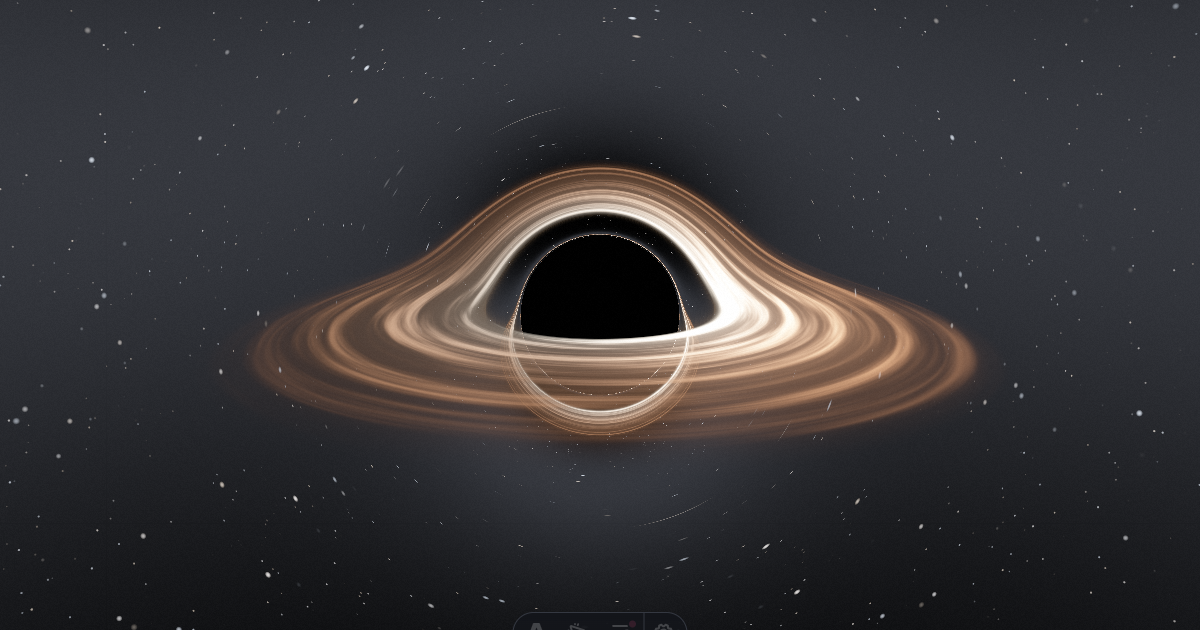
Your device cannot show the live view. The measurements and the fall work normally.
Earth
You
The screen runs on Earth time. Valid for someone hovering with a rocket at this distance.
What do you think happens when you fall into a black hole?
Your clock:
You crossed the horizon and are looking back. From here on the image is an artist's impression; the measurements remain exact.
- Horizon radius
- Time dilation: Hovering with a rocket
- Time dilation: In a circular orbit
- Tidal force, head to feet (2 m body)
Understand it
The horizon is not a wall
The event horizon is the distance from which not even light returns. There is no wall there: someone falling in crosses it with no local sign. The horizon radius grows in proportion to the mass, about 3 km per solar mass.
Why size changes everything
The tidal force is the difference in gravity between your head and your feet, and it falls with the cube of the distance. In a small black hole the horizon is so close to the centre that the tide tears any body apart long before it. In a supermassive one the horizon is so far out that the tide there is imperceptible.
Two clocks, two stories
A distant observer never sees you cross the horizon: your image slows, reddens and fades. By your own clock, the crossing takes a finite time. Both descriptions are correct; they are different clocks measuring the same event.
After the horizon
Inside, the singularity stops being a place and becomes a moment in your future. In free fall, the time left is two thirds of the horizon radius divided by the speed of light. Firing rockets does not save you: the maximum possible is a little more than twice that. What exists at the singularity, present-day physics cannot say.
How we calculate
Every measurement uses the Schwarzschild solution of general relativity: a black hole with no rotation and no electric charge.
- Horizon radius: r_s = 2GM/c².
- Time dilation for a hovering observer: √(1 − r_s/r).
- Time dilation in a circular orbit: √(1 − 3r_s/2r), for r ≥ 3 r_s.
- Tidal force between head and feet: 2GM·L/r³, with L = 2 m.
- Fall time to the singularity: (2/3)·(r_s/c)·(r/r_s)^(3/2).
- Edge of the shadow seen from afar: 2.6 times the horizon radius.
- Image: the path of each light ray integrated in the Schwarzschild geometry, for a stationary observer.
- Clocks on the image: Earth runs at screen pace; yours is multiplied by √(1 − r_s/r).
Approximations we make
- Real black holes spin; rotation changes the numbers near the horizon.
- The 10 g head-to-feet limit is a convention of this simulation, not a scientific value.
- The fall is computed as free fall starting from rest at a very large distance.
- The gas disk is illustrative.
- From the horizon inwards, the image is an artist's impression.
- Zoom and camera slow down along with your clock, with a 4% floor so the page stays usable; the clocks have no floor.
- The bluish tint of the stars near the horizon is illustrative; the shift factor of incoming light, 1/√(1 − r_s/r), is exact.
- Near the horizon the camera tilts its gaze upwards so the edge of the shadow stays visible; looking straight at the black hole the screen would be entirely black, which is the correct result.
Sources
- K. Schwarzschild (1916), Sitzungsberichte der Königlich Preussischen Akademie der Wissenschaften, 189-196.
- C. Misner, K. Thorne and J. Wheeler (1973), Gravitation, chapters 25, 31 and 32.
- G. Lewis and J. Kwan (2007), Publications of the Astronomical Society of Australia 24, 46.
- J.-P. Luminet (1979), Astronomy & Astrophysics 75, 228.
- Event Horizon Telescope Collaboration (2019), Astrophysical Journal Letters 875, L1.
- GRAVITY Collaboration (2022), Astronomy & Astrophysics 657, L12.